
What Causes High Humidity Inside Your Home in Southwest Florida?
Most people think of air conditioning as primarily a cooling technology, and it is, but in Southwest Florida it is equally a dehumidification technology. The outdoor relative humidity in our area regularly exceeds 80 to 90 percent during the summer rainy season. The amount of moisture the air carries into your home every time a door opens, through every gap in the building envelope, and through normal occupant activities is significantly higher than in most parts of the country. Your AC system has to continuously remove that moisture to maintain comfortable indoor conditions.
When the AC system is not keeping up with that moisture load, whether because of how it is sized, how it operates, how the building is sealed, or how the ductwork is configured, the result is a home that feels persistently damp, heavy, and uncomfortable even when the thermometer reads a reasonable temperature. We hear this complaint from homeowners throughout our service area and it almost always has an identifiable cause.
Oversized Air Conditioning: The Counterintuitive Cause
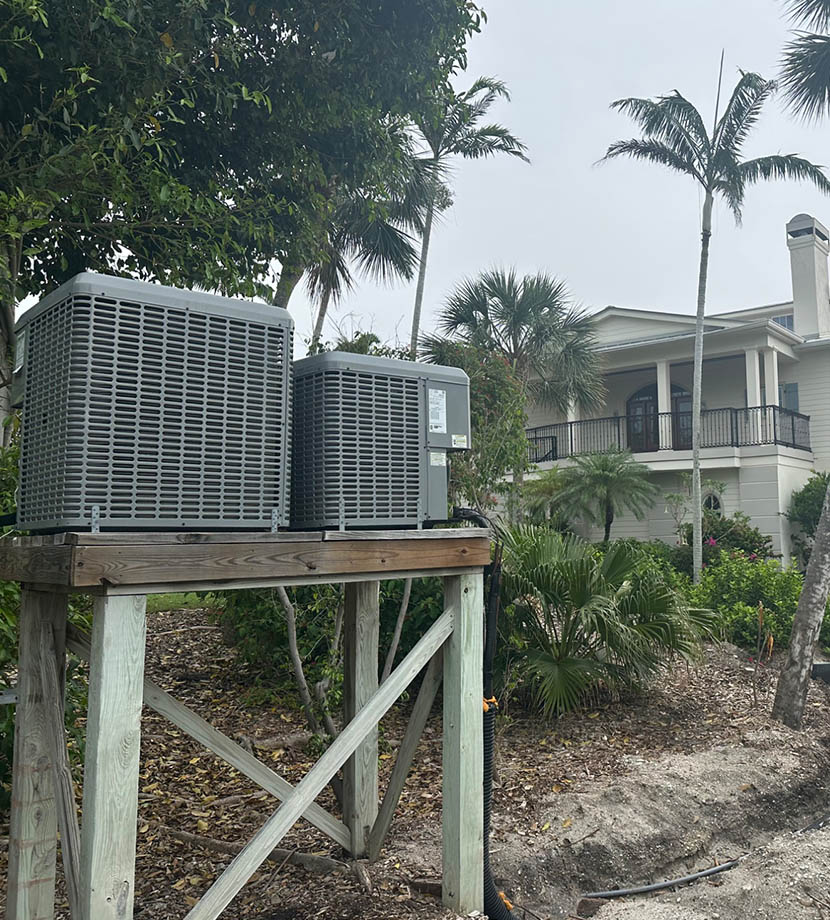
An oversized AC system is the most common cause of chronic indoor humidity problems in Southwest Florida homes, and it is genuinely counterintuitive until you understand how the dehumidification process works. Air conditioning removes moisture from your home by running warm, humid indoor air across the cold evaporator coil. Moisture in the air condenses on the coil surface and drains away. That condensation process requires time and continuous airflow contact with the cold coil surface.
An oversized system reaches the thermostat setpoint temperature quickly, often in 8 to 12 minutes, and shuts off. It cycles back on when the temperature drifts a degree or two, runs for another 8 to 12 minutes, and shuts off again. These short cycles maintain temperature but do not provide enough sustained coil contact time to remove significant moisture from the air. The home stays at 74 degrees but at 68 percent relative humidity, and that combination feels uncomfortable to most people.
We see this pattern commonly in newer construction communities throughout Estero and Naples where systems are sometimes specified slightly oversized, including in developments like Talis Park, Esplanade Lake Club, and Fiddler’s Creek. The homeowners in these communities often describe their new homes as feeling less comfortable than their previous homes despite having brand new, high-efficiency equipment.
Aging System Efficiency and Declining Dehumidification
In older neighborhoods throughout established Fort Myers communities including McGregor Isles, the Villas area, and established sections of Bonita Springs, systems that have been in service for 10 or more years without comprehensive maintenance sometimes present exactly this pattern: adequate temperature control but declining indoor air quality and comfort as dehumidification efficiency falls.
Building Envelope Infiltration
In older homes throughout Fort Myers Beach, Iona, and the Whiskey Creek area where weatherstripping and window seals have aged, and in homes on Sanibel Island and Captiva Island that experienced storm-related building envelope damage during Hurricane Ian and subsequent storms, infiltration often plays a meaningful role in chronic indoor humidity problems. Addressing the envelope is sometimes as important as addressing the HVAC system.
Duct System Leakage
This is a particularly significant issue in older homes throughout Lee and Collier counties where ductwork in unconditioned attic spaces has been in place for 20 or 30 years. The connections and joints in these systems have often been through enough thermal cycling to develop significant leakage. Duct sealing is among the highest-return-on-investment HVAC improvements available for these homes.

Seasonal and Occupancy Patterns That Affect Humidity
Seasonal residents who set their homes to a higher setpoint temperature during extended absences sometimes return to find elevated humidity and the associated musty odors that develop when a home runs at reduced cooling mode through a Florida summer. Running the AC at a setpoint of 80 or 82 degrees to save energy while the home is unoccupied is understandable, but at those temperatures the system may not be removing enough moisture to prevent biological growth in the home’s materials and HVAC components over an extended absence.
For seasonal residents in communities like Pelican Bay, Park Shore, The Moorings, and Old Naples, we recommend setting the thermostat to 78 degrees maximum during extended absences rather than higher, and pairing it with a whole-home dehumidifier set to maintain humidity below 55 percent. This combination protects the home and its contents without running the full cooling load unnecessarily.
When a Whole-Home Dehumidifier Is the Answer
Whole-home dehumidifiers are particularly effective for homes that experience the oversized AC short-cycling problem, homes with building envelopes that are difficult to seal completely, and homes where seasonal occupancy patterns create challenges for standard AC humidity control. Our team installs these systems throughout our service area and they consistently produce noticeable comfort improvements for homeowners who have struggled with chronic humidity issues.
Recent Customer Reviews
EXCELLENTTrustindex verifies that the original source of the review is Google. Germayne T. was very professional, courteous, and extremely efficient replacing two ceiling fans for us. Will definitely use Mabry and Germaine again.Posted on GoogleTrustindex verifies that the original source of the review is Google. Just had a biannual service done to my AC, amazing work by Kirk, on time, professional, and efficient!!!Posted on GoogleTrustindex verifies that the original source of the review is Google. Our A/C system wasn’t cooling. Kirk was over to fix it in less than 2 hrs. Very friendly & efficient. Found 2 small leaks. Got system cooling. Went over all options & charges before proceeding. Very satisfied.Posted on GoogleTrustindex verifies that the original source of the review is Google. Amazing professional service! I had smoke detectors falsely alarming and when I called in the morning, Scott immediately had a tech rerouted to address the alarms. Germaine arrived with 15 minutes of my call. He was AWESOME! Knowledgeable, polite and so personable. 5 star🌟 . And that is what we have found with all Mabry Brothers service techs!!!!Posted on GoogleTrustindex verifies that the original source of the review is Google. I love using these guys when I need an electrician. Their prices are fair, service is always fast and on time, and they communicate really well. Today Germayne T came out to install an EV charger at our home. He was on time, worked hard trenching ~80’, and got creative to help minimize the amount of exposed PVC. His connections look great, and the charger is working perfectly. As I said, I really like working with Mabry, and I think you will too.Posted on GoogleTrustindex verifies that the original source of the review is Google. My AC randomly went out in the late afternoon and I thought it had to do with the battery on the thermostat or the filter needing to be changed but it ended up being 84 degrees in my house in the middle of the night and Kirk was able to get to me within an hour of me calling to fix my issue which happened to be the capacitor. He spotted the issue within 10 minutes, thank you so much!!!Posted on GoogleTrustindex verifies that the original source of the review is Google. Company was very responsive. Germayne was knowledgeable, efficient, and cleaned up after work. Very professional! I highly recommend Mabry Brothers for your electrical needs.Posted on GoogleTrustindex verifies that the original source of the review is Google. I was very pleased with the service call. Kirk arrived on time, was professional and knowledgeable about the problems we were having with our air conditioner. He explained in detail what was happening and the steps needed to correct them. I highly recommend Mabry Brothers.Posted on GoogleTrustindex verifies that the original source of the review is Google. We needed an outdoor low voltage circuit installed! Emailed Scott for a quote with quick turnaround and Martin showed up and did excellent install work! Can highly recommend Mabry Brothers from this first experience and will use again!Posted on GoogleTrustindex verifies that the original source of the review is Google. Troy from Mabry Brothers is extremely professional and truly knows 100% what he’s doing. He is very responsible and takes the time to explain every step of the process, including every part that needs to be replaced. After calling several different companies, nobody was able to repair my generator and I only ended up wasting money. Troy was the only one who actually solved the problem quickly, and now my generator is working perfectly just in time for the upcoming storms. I highly recommend Troy and Mabry Brothers to anyone looking for honest, knowledgeable, and reliable service.
Frequently Asked Questions
Need Service in Southwest Florida?
The licensed electricians and HVAC technicians at Mabry Brothers have served Fort Myers, Estero, Bonita Springs, Naples, Sanibel Island, and Captiva Island since 1995.
For immediate assistance, please call our office directly at (239) 482-1122.

