
Why Does My AC Keep Freezing Up?
Of all the AC questions we hear from homeowners throughout Southwest Florida, this one generates the most genuine surprise. How does an air conditioner freeze up when it is 93 degrees outside? The answer is that the evaporator coil inside your air handler is designed to operate at temperatures around 40 degrees Fahrenheit regardless of outdoor conditions. It absorbs heat from your home’s air, which keeps it from dropping below freezing under normal operating conditions. When something disrupts that heat absorption, whether it is insufficient airflow, not enough refrigerant, or a mechanical issue, the coil temperature can drop below 32 degrees and condensation on the coil surface begins to freeze. Once ice starts forming, it insulates the coil from the air and the problem compounds rapidly.
Freeze-up is actually one of the more common AC service calls we handle throughout our service area, particularly in the early summer months when systems that have sat partially idle through the cooler months are suddenly being pushed hard again.
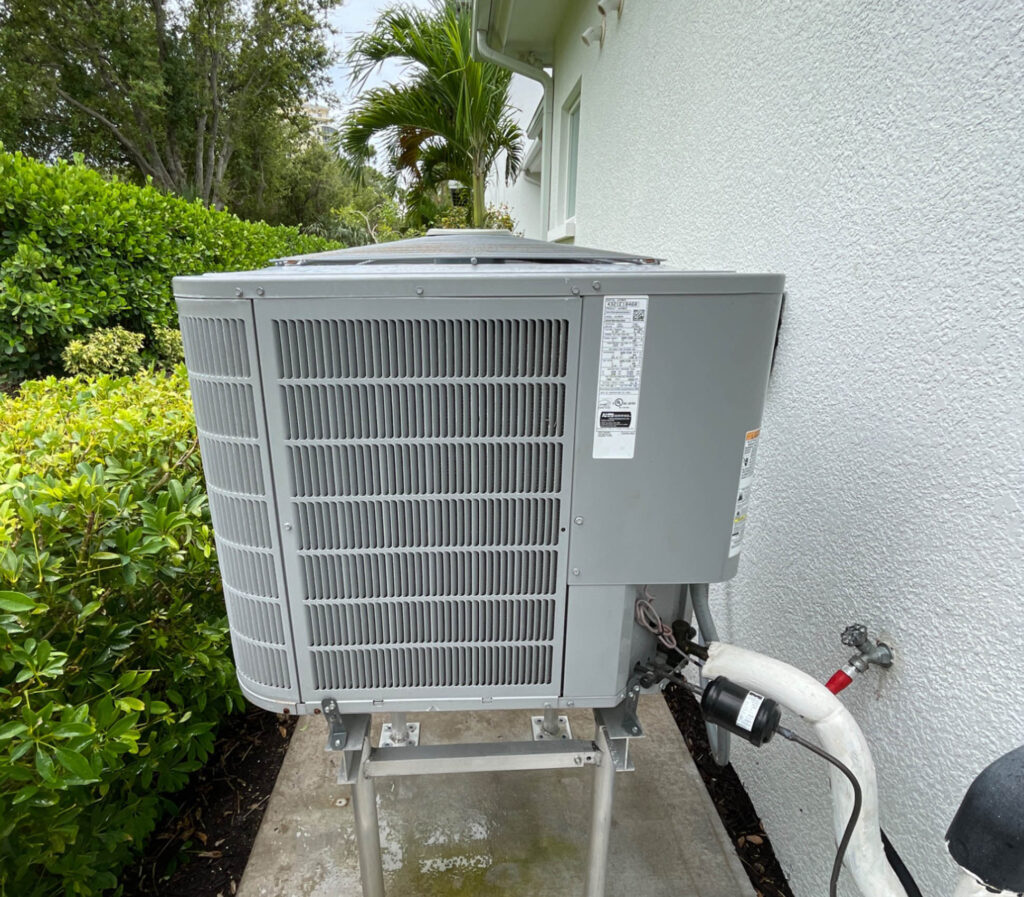
Restricted Airflow
Restricted airflow is the most common cause of a freezing AC system, and the most common source of restricted airflow is a dirty filter. When the volume of air moving across the evaporator coil drops below the system’s designed airflow, the coil does not receive enough heat from the air to stay above freezing. Ice forms, the ice insulates the coil, less air gets through, more ice forms, and within a few hours the entire coil can be encased in a solid block of ice.
We see this regularly in older homes throughout the Villas area and the McGregor corridor in Fort Myers where maintenance has sometimes been deferred, but also in newer communities like Verdana Village in Estero and Esplanade Lake Club in Fort Myers where homeowners may not yet be familiar with how quickly filters load up in Florida. Beyond the filter, blocked return air grilles, closed supply vents, or collapsed flex duct in the attic can also restrict airflow enough to cause freezing. Attic ductwork throughout the older sections of Iona and the Villas neighborhood in Fort Myers has in some cases been in place for 30 or more years and is worth inspecting if freeze-up is a recurring problem.
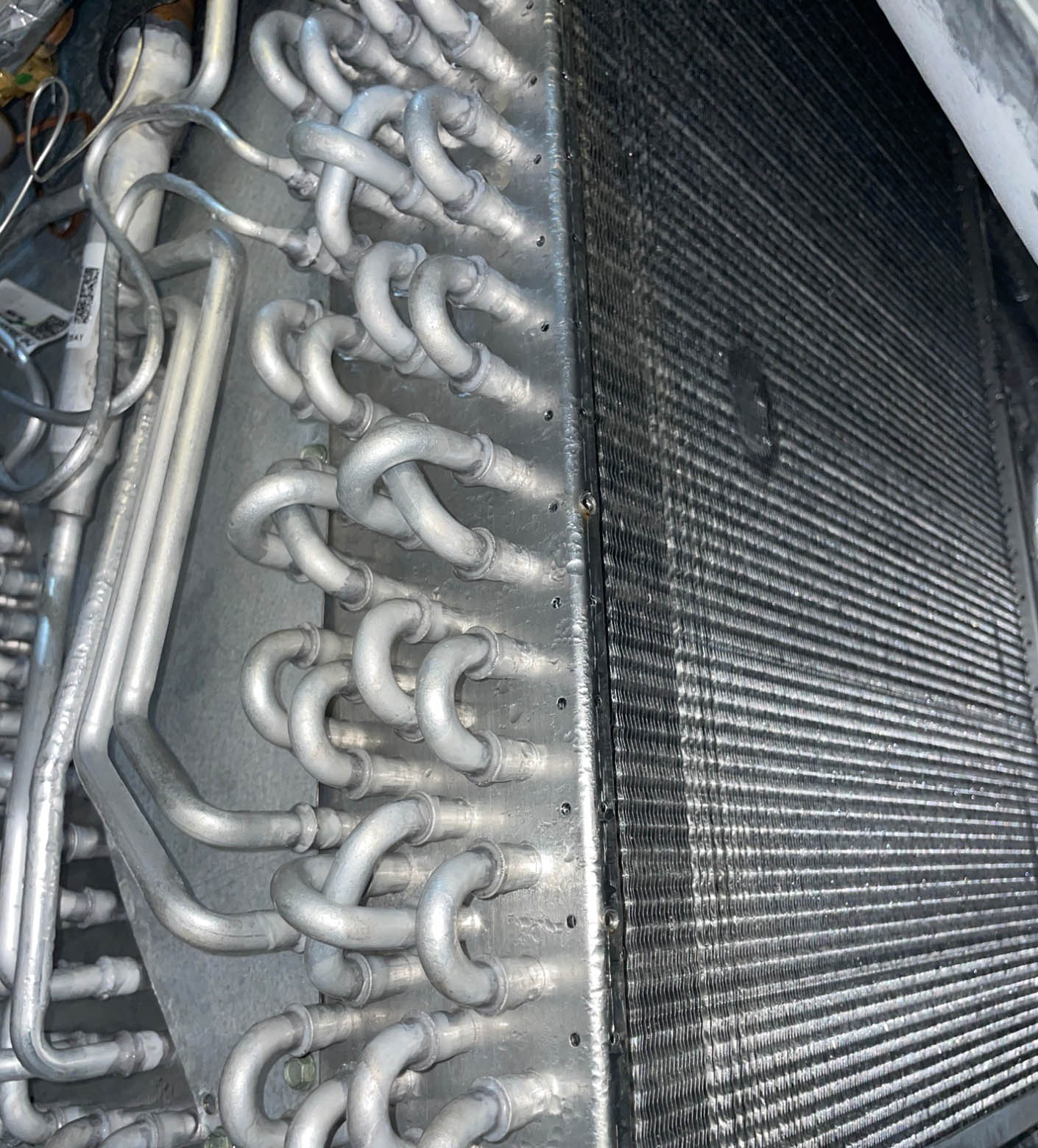
Low Refrigerant
If your system freezes consistently even with a clean filter and clear airflow, a refrigerant leak is the likely explanation. Our technicians use electronic leak detection to locate the source accurately, and we repair the leak before recharging the system. Simply adding refrigerant to a leaking system is a temporary measure that delays the problem and risks compressor damage.
Blower Motor Issues
Running the System in Cool Overnight Conditions

What to Do When Your System Is Frozen Right Now
Switch the thermostat to fan-only mode immediately. This circulates room-temperature air across the frozen coil to melt the ice without running the refrigerant cycle, which is important because running the compressor while the coil is frozen can send liquid refrigerant back to the compressor and cause serious damage. Allow the system to thaw completely, which typically takes one to three hours depending on how much ice has accumulated. Do not try to chip or scrape ice off the coil. After thawing, check and replace the filter before switching back to cooling mode.
If the system freezes again after thawing and filter replacement, call our office. Repeated freeze-up after addressing the filter is a sign of a refrigerant leak or a blower issue that needs professional diagnosis.
How to Prevent It From Happening Again
Recent Customer Reviews
EXCELLENTTrustindex verifies that the original source of the review is Google. Germayne T. was very professional, courteous, and extremely efficient replacing two ceiling fans for us. Will definitely use Mabry and Germaine again.Posted on GoogleTrustindex verifies that the original source of the review is Google. Just had a biannual service done to my AC, amazing work by Kirk, on time, professional, and efficient!!!Posted on GoogleTrustindex verifies that the original source of the review is Google. Our A/C system wasn’t cooling. Kirk was over to fix it in less than 2 hrs. Very friendly & efficient. Found 2 small leaks. Got system cooling. Went over all options & charges before proceeding. Very satisfied.Posted on GoogleTrustindex verifies that the original source of the review is Google. Amazing professional service! I had smoke detectors falsely alarming and when I called in the morning, Scott immediately had a tech rerouted to address the alarms. Germaine arrived with 15 minutes of my call. He was AWESOME! Knowledgeable, polite and so personable. 5 star🌟 . And that is what we have found with all Mabry Brothers service techs!!!!Posted on GoogleTrustindex verifies that the original source of the review is Google. I love using these guys when I need an electrician. Their prices are fair, service is always fast and on time, and they communicate really well. Today Germayne T came out to install an EV charger at our home. He was on time, worked hard trenching ~80’, and got creative to help minimize the amount of exposed PVC. His connections look great, and the charger is working perfectly. As I said, I really like working with Mabry, and I think you will too.Posted on GoogleTrustindex verifies that the original source of the review is Google. My AC randomly went out in the late afternoon and I thought it had to do with the battery on the thermostat or the filter needing to be changed but it ended up being 84 degrees in my house in the middle of the night and Kirk was able to get to me within an hour of me calling to fix my issue which happened to be the capacitor. He spotted the issue within 10 minutes, thank you so much!!!Posted on GoogleTrustindex verifies that the original source of the review is Google. Company was very responsive. Germayne was knowledgeable, efficient, and cleaned up after work. Very professional! I highly recommend Mabry Brothers for your electrical needs.Posted on GoogleTrustindex verifies that the original source of the review is Google. I was very pleased with the service call. Kirk arrived on time, was professional and knowledgeable about the problems we were having with our air conditioner. He explained in detail what was happening and the steps needed to correct them. I highly recommend Mabry Brothers.Posted on GoogleTrustindex verifies that the original source of the review is Google. We needed an outdoor low voltage circuit installed! Emailed Scott for a quote with quick turnaround and Martin showed up and did excellent install work! Can highly recommend Mabry Brothers from this first experience and will use again!Posted on GoogleTrustindex verifies that the original source of the review is Google. Troy from Mabry Brothers is extremely professional and truly knows 100% what he’s doing. He is very responsible and takes the time to explain every step of the process, including every part that needs to be replaced. After calling several different companies, nobody was able to repair my generator and I only ended up wasting money. Troy was the only one who actually solved the problem quickly, and now my generator is working perfectly just in time for the upcoming storms. I highly recommend Troy and Mabry Brothers to anyone looking for honest, knowledgeable, and reliable service.
Frequently Asked Questions
Need Service in Southwest Florida?
The licensed electricians and HVAC technicians at Mabry Brothers have served Fort Myers, Estero, Bonita Springs, Naples, Sanibel Island, and Captiva Island since 1995.
For immediate assistance, please call our office directly at (239) 482-1122.

