
What Size Air Conditioner Does My Southwest Florida Home Need?
The single most important thing we can communicate about AC sizing is this: bigger is not better. This runs directly counter to a common intuition, particularly among homeowners who have experienced a house that was hard to cool in summer. The impulse is to solve that problem by installing more capacity. But in most cases, the right answer is not a larger system. It is a correctly sized system, a sealed duct system, and a properly maintained one. Oversizing creates a new set of problems that many homeowners live with for years without understanding why their home is never quite comfortable despite having new equipment.
How AC Size Is Measured
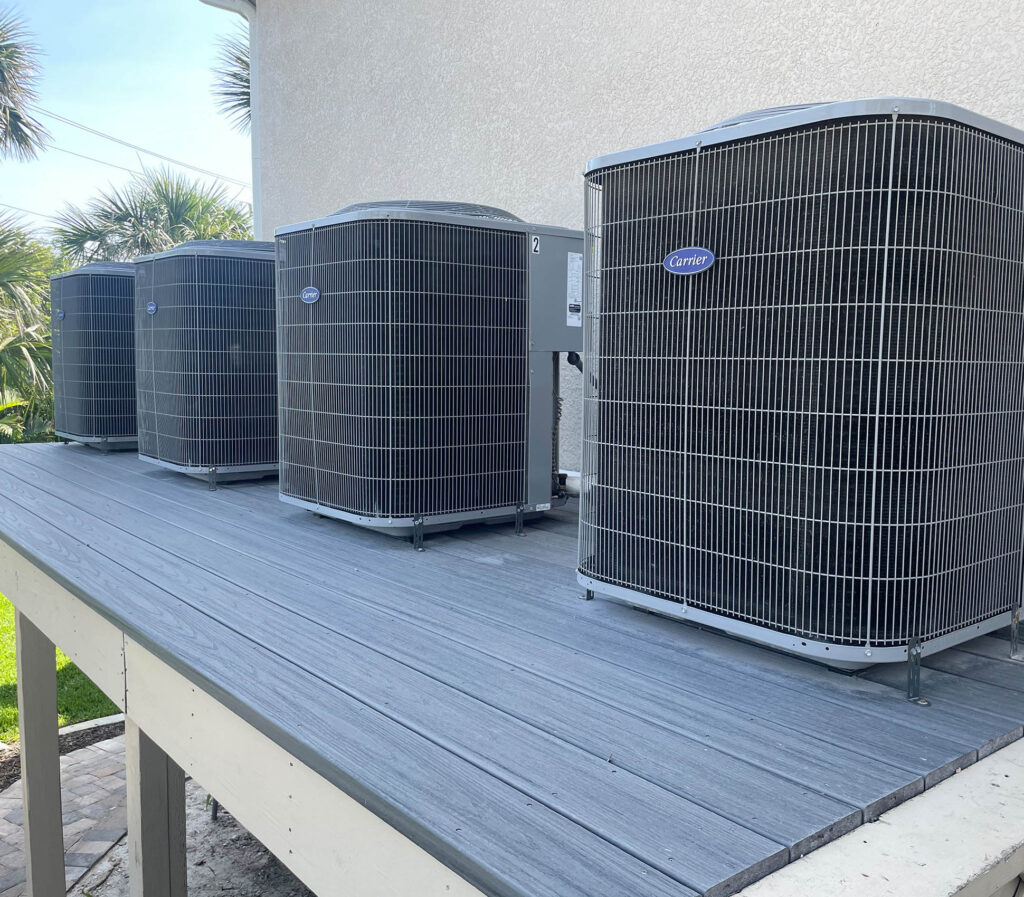
Air conditioning capacity is measured in tons, where one ton equals 12,000 BTUs per hour of cooling capacity. Residential systems in Southwest Florida typically range from 1.5 tons for small conditioned spaces to 5 tons or more for large single-family homes. Larger estate properties with multiple zones and separate systems can have total installed capacity of 10 tons or more.
The right size for a specific home is determined by a Manual J load calculation, not by home square footage, not by what the previous system was, and not by what the neighbor has. Square footage-based rules of thumb produce oversized systems in Florida more often than not because they do not account for the specific insulation levels, window areas, orientation, shading, and occupancy characteristics of the individual home.
Why Oversizing Is So Common and Why It Matters
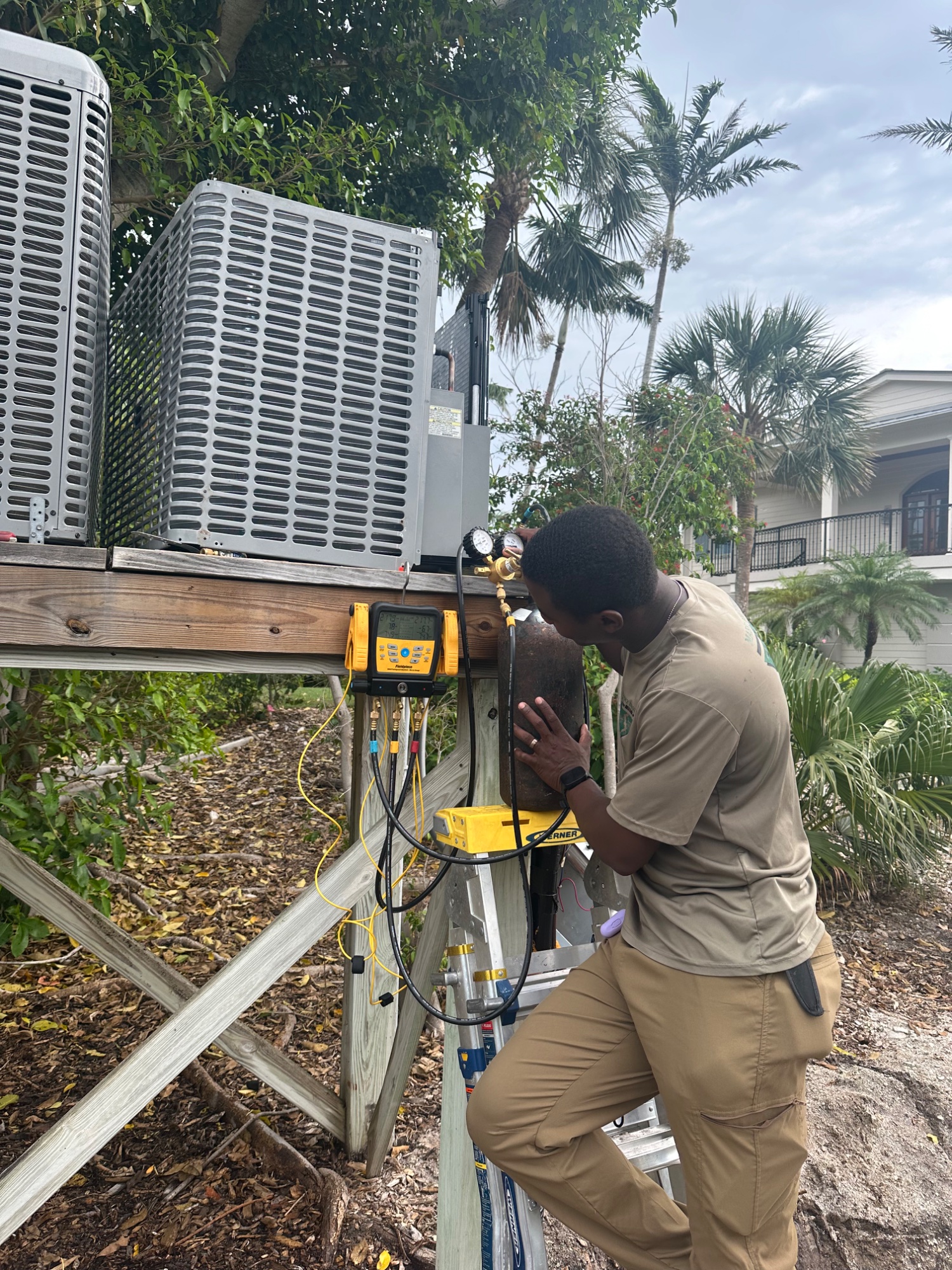
An oversized system reaches temperature setpoint quickly and shuts off, cycles back on when the temperature drifts a few degrees, and shuts off again. This short-cycling pattern keeps the home at a temperature that satisfies the thermostat but never runs long enough to complete meaningful dehumidification. The home feels cool but clammy. Residents in communities throughout Estero, Bonita Springs, and Naples in newer construction with oversized systems describe this experience frequently. The fix is either accepting the humidity discomfort, running the system at a lower temperature setpoint to extend run cycles, installing a whole-home dehumidifier, or replacing the system with correctly sized equipment when the time comes.
Why Undersizing Creates a Different Set of Problems
Undersizing is less common than oversizing in our market but does occur, particularly in homes that have added conditioned square footage through enclosed lanais or additions without updating the HVAC system to serve the expanded space.
What a Proper Manual J Load Calculation Involves
Our team performs Manual J calculations as standard practice before every system replacement we quote. A customer in Pelican Landing in Estero and a customer in a similarly sized home in the McGregor corridor in Fort Myers may end up with different equipment recommendations even if their homes look similar on paper, because the specific insulation levels, window configurations, and building characteristics of those individual properties produce different load numbers.

How Sizing Needs Vary Across Southwest Florida Communities
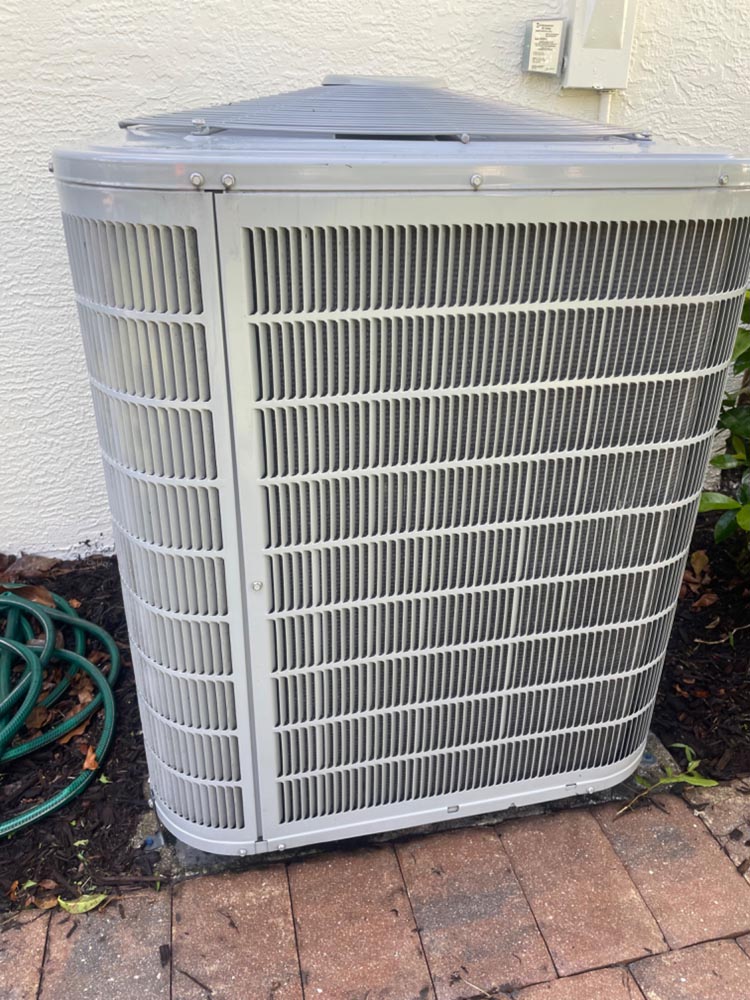
Understanding how sizing typically plays out across our service area helps set expectations. Older construction in Fort Myers neighborhoods like Whiskey Creek, McGregor Isles, and Iona often has older insulation that does not meet modern standards, single-pane windows, and building envelopes that have accumulated infiltration pathways over decades. The cooling load per square foot is typically higher than for modern construction, and the Manual J reflects that.
Newer construction throughout Estero in communities like Raptor Bay, Estero Bay Preserve, and Bella Terra uses modern insulation standards, Low-E windows, and tighter construction that reduces the cooling load per square foot compared to older homes. Sizing is typically more conservative for these homes, and oversizing is more likely to cause noticeable humidity problems because the tighter envelope means outdoor air infiltration does not help dry out the interior.
Premium construction in communities like Quail West, Mediterra, and the waterfront estates of Naples and the Islands sometimes involves specialized architectural features including large glass areas, atriums, or unconventional ceiling geometries that require careful Manual J analysis to size correctly. These are not homes where a quick rule of thumb produces reliable results.
Why Variable-Speed Systems Are Changing the Sizing Conversation
Variable-speed systems are increasingly our standard recommendation throughout Southwest Florida precisely because of this characteristic. In a climate where humidity control is as important as temperature control, a system that runs continuously at partial capacity does the job better than one that hammers on and off at full capacity. They are also significantly more energy efficient than single-stage systems and qualify for utility rebate programs through FPL and LCEC.
Recent Customer Reviews
EXCELLENTTrustindex verifies that the original source of the review is Google. Germayne T. was very professional, courteous, and extremely efficient replacing two ceiling fans for us. Will definitely use Mabry and Germaine again.Posted on GoogleTrustindex verifies that the original source of the review is Google. Just had a biannual service done to my AC, amazing work by Kirk, on time, professional, and efficient!!!Posted on GoogleTrustindex verifies that the original source of the review is Google. Our A/C system wasn’t cooling. Kirk was over to fix it in less than 2 hrs. Very friendly & efficient. Found 2 small leaks. Got system cooling. Went over all options & charges before proceeding. Very satisfied.Posted on GoogleTrustindex verifies that the original source of the review is Google. Amazing professional service! I had smoke detectors falsely alarming and when I called in the morning, Scott immediately had a tech rerouted to address the alarms. Germaine arrived with 15 minutes of my call. He was AWESOME! Knowledgeable, polite and so personable. 5 star🌟 . And that is what we have found with all Mabry Brothers service techs!!!!Posted on GoogleTrustindex verifies that the original source of the review is Google. I love using these guys when I need an electrician. Their prices are fair, service is always fast and on time, and they communicate really well. Today Germayne T came out to install an EV charger at our home. He was on time, worked hard trenching ~80’, and got creative to help minimize the amount of exposed PVC. His connections look great, and the charger is working perfectly. As I said, I really like working with Mabry, and I think you will too.Posted on GoogleTrustindex verifies that the original source of the review is Google. My AC randomly went out in the late afternoon and I thought it had to do with the battery on the thermostat or the filter needing to be changed but it ended up being 84 degrees in my house in the middle of the night and Kirk was able to get to me within an hour of me calling to fix my issue which happened to be the capacitor. He spotted the issue within 10 minutes, thank you so much!!!Posted on GoogleTrustindex verifies that the original source of the review is Google. Company was very responsive. Germayne was knowledgeable, efficient, and cleaned up after work. Very professional! I highly recommend Mabry Brothers for your electrical needs.Posted on GoogleTrustindex verifies that the original source of the review is Google. I was very pleased with the service call. Kirk arrived on time, was professional and knowledgeable about the problems we were having with our air conditioner. He explained in detail what was happening and the steps needed to correct them. I highly recommend Mabry Brothers.Posted on GoogleTrustindex verifies that the original source of the review is Google. We needed an outdoor low voltage circuit installed! Emailed Scott for a quote with quick turnaround and Martin showed up and did excellent install work! Can highly recommend Mabry Brothers from this first experience and will use again!Posted on GoogleTrustindex verifies that the original source of the review is Google. Troy from Mabry Brothers is extremely professional and truly knows 100% what he’s doing. He is very responsible and takes the time to explain every step of the process, including every part that needs to be replaced. After calling several different companies, nobody was able to repair my generator and I only ended up wasting money. Troy was the only one who actually solved the problem quickly, and now my generator is working perfectly just in time for the upcoming storms. I highly recommend Troy and Mabry Brothers to anyone looking for honest, knowledgeable, and reliable service.
Frequently Asked Questions
Need Service in Southwest Florida?
The licensed electricians and HVAC technicians at Mabry Brothers have served Fort Myers, Estero, Bonita Springs, Naples, Sanibel Island, and Captiva Island since 1995.
For immediate assistance, please call our office directly at (239) 482-1122.

