
What Happens to Your AC System During a Florida Hurricane?
We have been serving Southwest Florida since 1995, which means our team has been through enough major storm events to understand what hurricane conditions actually do to residential AC systems. Hurricane Ian in September 2022 was particularly instructive because it was the kind of direct, catastrophic impact that exposes every vulnerability in a system. We spent months after Ian assessing, repairing, and replacing AC systems throughout Lee County, from Fort Myers to Fort Myers Beach and the communities of Pine Island, Matlacha, St. James City, Sanibel Island, and Captiva Island.
What we saw ranged from systems that came through with no damage at all to systems that were completely destroyed by storm surge flooding. The difference in outcomes was not random. Preparation before the storm, system condition going in, and the specific exposure of individual properties all contributed to how systems fared. We want to share what we learned so homeowners throughout our service area are better prepared for the next major storm season.
How Hurricanes Damage AC Systems
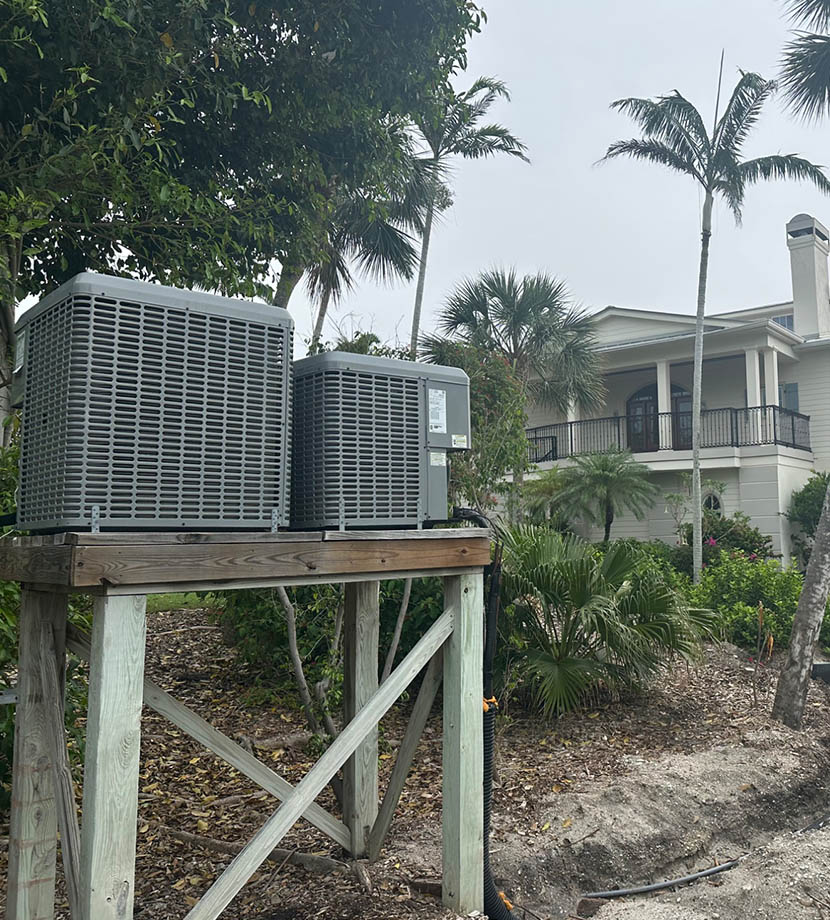
Hurricane damage to AC systems comes from several distinct mechanisms. Wind-driven debris is a significant threat to outdoor condenser units. A condenser that is struck by debris from a neighboring property can sustain fin damage to the coil, blade damage to the condenser fan, or in severe cases damage to the compressor housing itself. Properties throughout Fort Myers, Estero, and Bonita Springs that had unprotected or poorly located outdoor units near trees, fencing, or neighboring structures experienced higher rates of debris damage during Ian.
Storm surge flooding is the most destructive mechanism for HVAC systems in coastal communities. Outdoor condenser units that are submerged in saltwater sustain corrosion and internal contamination that is not always visible from outside but renders the unit unreliable or non-functional. Air handlers that are flooded require complete replacement rather than repair. Ductwork in flooded spaces absorbs moisture and in many cases requires replacement or professional remediation before the system can safely be returned to operation.
Power surges associated with storm activity, both during the storm as the grid fluctuates and at power restoration when voltage ramps back up, can damage electronic control boards and capacitors even in systems that experience no physical damage at all.
What to Do Before a Storm Arrives
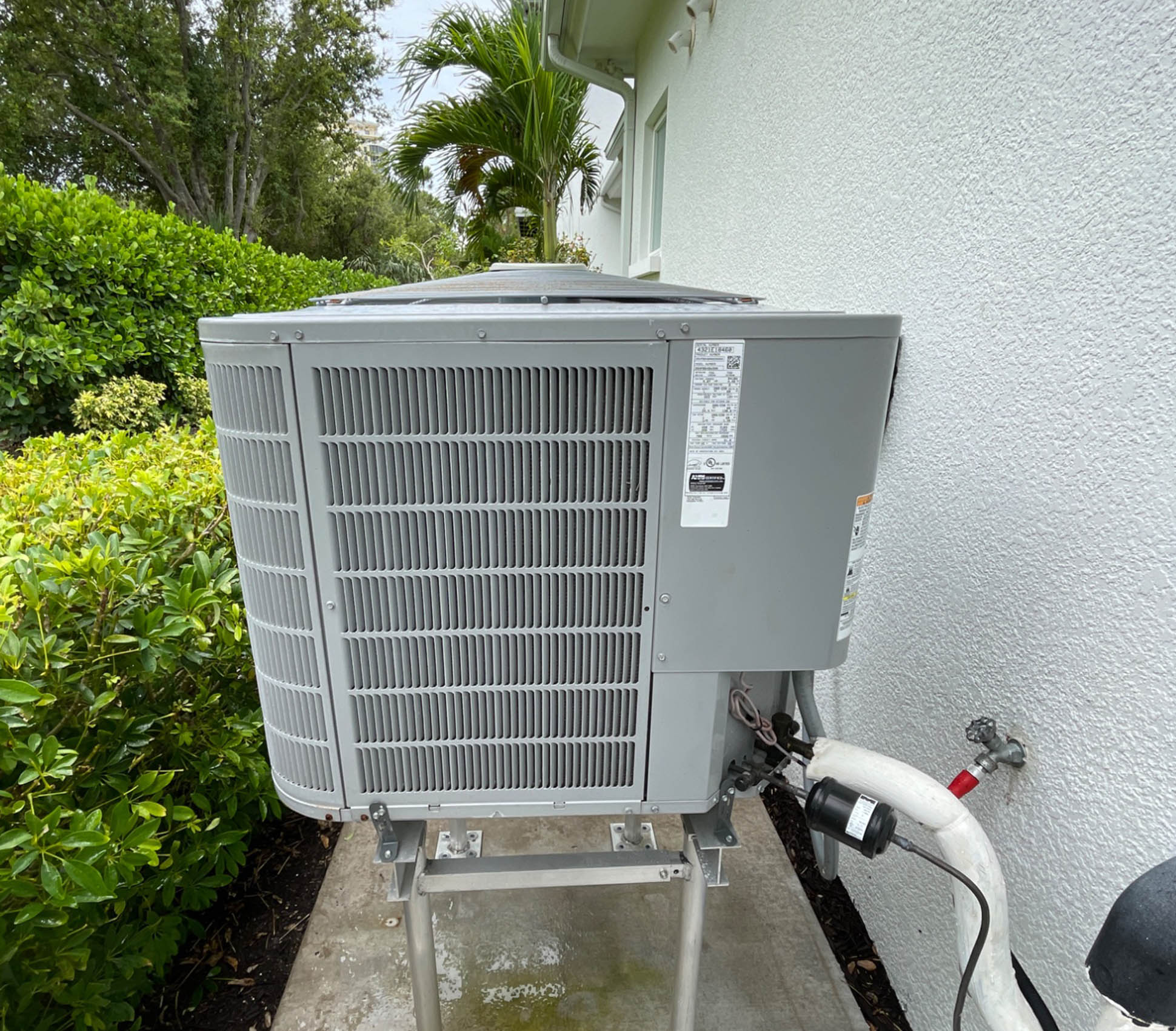
The most important step before a hurricane is making sure your AC system is turned off at the thermostat before the storm arrives. This accomplishes two things: it protects the system from surge damage as power fluctuates during the storm, and it ensures the system is not attempting to run while the outdoor unit is being subjected to high winds and potential debris impact. Condenser units are not designed to run in hurricane-force winds.
If you have time and the storm track gives you reason to believe surge flooding is possible at your property, and you are in one of the lower-elevation areas of Fort Myers Beach, Bonita Beach, the southern sections of the Fort Myers waterfront near the river, or the coastal areas of Estero and Naples, consider whether your outdoor unit can be elevated temporarily or moved to a more protected location. For most homeowners this is not practical, but for properties with demonstrated flood history it may be worth the effort.
Securing the area around the outdoor unit, removing potential debris items from the surrounding area, and ensuring the unit is on a sound concrete pad that is secured to the ground addresses the wind-related risk to the extent you can. Some homeowners in communities throughout Pelican Bay, Grey Oaks, and similar well-landscaped communities also trim vegetation near outdoor units before major storms to reduce the debris load.
What Not to Do Before a Storm
Do not try to run the system continuously before a storm to pre-cool the home as much as possible and then turn it off. Running the system up until the storm arrives is fine, but continuous aggressive cooling in the hours before a major storm does not meaningfully delay the inevitable temperature rise during the outage period that follows.
After the Storm: What to Check Before Restarting Your System
Do not restart the AC system immediately after a storm without first doing a visual assessment. Walk around the outdoor unit and look for visible physical damage, dents in the coil area, bent or broken fan blades, debris inside the unit, and any evidence of water intrusion into the unit. Check that the condenser coil fins are reasonably intact and not collapsed. Check that the refrigerant lines running into the home have not been kinked or damaged.
If the outdoor unit shows evidence of submersion or if your property experienced any flooding at all, do not restart the AC without professional assessment. Submerged compressors require specific inspection and restart protocols. Restarting a compressor that was submerged in saltwater without following proper procedures risks permanent compressor damage. Our team can assess the specific condition of a flood-affected system and advise on whether restart, repair, or replacement is appropriate.
If there was no apparent flooding or physical damage, and the unit passed your visual inspection, restore power at the circuit breaker and set the thermostat to its normal cooling mode. Listen carefully for the first several minutes of operation for any unusual sounds that might indicate damage that was not visible externally.

When a Post-Storm AC Assessment Is Necessary
A professional AC assessment after a storm is warranted whenever the outdoor unit shows any physical damage, whenever the property experienced any flooding, whenever the system does not start or operate normally after power is restored, or whenever you notice a significant decline in cooling performance in the weeks following a major storm event. Some storm-related damage to refrigerant circuits, control boards, and electrical components manifests gradually rather than immediately, and a system that seems to be working normally immediately after a storm can develop symptoms over the following weeks as damage progresses.
We performed hundreds of post-storm AC assessments throughout Lee and Collier counties following Hurricane Ian, and a significant number of those assessments identified damage that was not apparent from surface inspection alone. The salt water exposure that condenser units in flooded areas experienced is particularly insidious because corrosion of internal components continues well after the visible water has receded.
What We Saw in Lee County After Hurricane Ian
Hurricane Ian made landfall near Fort Myers Beach on September 28, 2022, as a Category 4 storm with a storm surge that exceeded 12 feet in some coastal areas. The HVAC damage profile we encountered throughout our service area reflected the geographic spread of the damage.
In Fort Myers Beach, San Carlos Island, and the low-lying waterfront neighborhoods of south Fort Myers along Matanzas Pass, essentially every property that experienced storm surge had outdoor condenser units that were submerged and required replacement. Air handlers on ground floors of flooded properties were similarly affected.
In the Iona area, Whiskey Creek, and south Fort Myers neighborhoods, wind damage was more common than surge damage. Condenser units damaged by wind-driven debris, downed fence sections, and branches from neighboring properties were among the most frequent repairs.
On Sanibel Island and Captiva Island, the combination of surge flooding, wind damage, and the extended period before power restoration created conditions where many systems required full replacement rather than repair. The Island communities faced the additional challenge of access restrictions during the initial recovery period that delayed assessment and repair work.
In communities further inland throughout Estero, Bonita Springs, and Naples, electrical damage from surges and power restoration events was more common than physical storm damage. Control board failures and capacitor damage in the weeks following the storm were a consistent pattern throughout our service area.
Recent Customer Reviews
EXCELLENTTrustindex verifies that the original source of the review is Google. Germayne T. was very professional, courteous, and extremely efficient replacing two ceiling fans for us. Will definitely use Mabry and Germaine again.Posted on GoogleTrustindex verifies that the original source of the review is Google. Just had a biannual service done to my AC, amazing work by Kirk, on time, professional, and efficient!!!Posted on GoogleTrustindex verifies that the original source of the review is Google. Our A/C system wasn’t cooling. Kirk was over to fix it in less than 2 hrs. Very friendly & efficient. Found 2 small leaks. Got system cooling. Went over all options & charges before proceeding. Very satisfied.Posted on GoogleTrustindex verifies that the original source of the review is Google. Amazing professional service! I had smoke detectors falsely alarming and when I called in the morning, Scott immediately had a tech rerouted to address the alarms. Germaine arrived with 15 minutes of my call. He was AWESOME! Knowledgeable, polite and so personable. 5 star🌟 . And that is what we have found with all Mabry Brothers service techs!!!!Posted on GoogleTrustindex verifies that the original source of the review is Google. I love using these guys when I need an electrician. Their prices are fair, service is always fast and on time, and they communicate really well. Today Germayne T came out to install an EV charger at our home. He was on time, worked hard trenching ~80’, and got creative to help minimize the amount of exposed PVC. His connections look great, and the charger is working perfectly. As I said, I really like working with Mabry, and I think you will too.Posted on GoogleTrustindex verifies that the original source of the review is Google. My AC randomly went out in the late afternoon and I thought it had to do with the battery on the thermostat or the filter needing to be changed but it ended up being 84 degrees in my house in the middle of the night and Kirk was able to get to me within an hour of me calling to fix my issue which happened to be the capacitor. He spotted the issue within 10 minutes, thank you so much!!!Posted on GoogleTrustindex verifies that the original source of the review is Google. Company was very responsive. Germayne was knowledgeable, efficient, and cleaned up after work. Very professional! I highly recommend Mabry Brothers for your electrical needs.Posted on GoogleTrustindex verifies that the original source of the review is Google. I was very pleased with the service call. Kirk arrived on time, was professional and knowledgeable about the problems we were having with our air conditioner. He explained in detail what was happening and the steps needed to correct them. I highly recommend Mabry Brothers.Posted on GoogleTrustindex verifies that the original source of the review is Google. We needed an outdoor low voltage circuit installed! Emailed Scott for a quote with quick turnaround and Martin showed up and did excellent install work! Can highly recommend Mabry Brothers from this first experience and will use again!Posted on GoogleTrustindex verifies that the original source of the review is Google. Troy from Mabry Brothers is extremely professional and truly knows 100% what he’s doing. He is very responsible and takes the time to explain every step of the process, including every part that needs to be replaced. After calling several different companies, nobody was able to repair my generator and I only ended up wasting money. Troy was the only one who actually solved the problem quickly, and now my generator is working perfectly just in time for the upcoming storms. I highly recommend Troy and Mabry Brothers to anyone looking for honest, knowledgeable, and reliable service.
Frequently Asked Questions
Need Service in Southwest Florida?
The licensed electricians and HVAC technicians at Mabry Brothers have served Fort Myers, Estero, Bonita Springs, Naples, Sanibel Island, and Captiva Island since 1995.
For immediate assistance, please call our office directly at (239) 482-1122.

