
Why the Scope of the Visit Matters
Not all AC maintenance visits are the same, and the difference between a thorough visit and a superficial one can determine whether the maintenance actually does what it is supposed to do. We want to be specific about what a proper maintenance visit covers because it helps you understand the value of what you are investing in and gives you a basis for evaluating what you have been getting from whoever has been servicing your system.
Our technicians work through a documented checklist on every visit. Every item on that list is there because it either prevents a common failure mode in Southwest Florida’s climate, provides performance data that helps us track system condition over time, or identifies a developing problem before it becomes an emergency. Nothing on the list is there for show.
Air Filter Inspection and Replacement
The filter check is genuinely the first step rather than the only step, but it is a critical one. A filter that is heavily loaded restricts airflow and affects the accuracy of everything else we measure during the visit. We note the filter condition, replace it if needed, and discuss the appropriate replacement interval for your specific home based on the filter type, your indoor air quality situation, and how quickly your system’s filter tends to load in your environment.
In older communities throughout the McGregor corridor, the Villas, and Iona where home construction has accumulated years of dust and particulate infiltration, we sometimes find filters that have loaded significantly faster than the homeowner expected. Calibrating expectations around filter replacement frequency is part of what we cover during the visit.
Evaporator Coil Inspection and Cleaning
We inspect the coil on every visit and clean it when cleaning is warranted. In Southwest Florida's environment, coil biological growth is a year-round concern because the coil operates in a persistently warm and moist environment that supports mold and algae growth continuously. UV light systems installed in the air handler significantly reduce this growth and are something we discuss with customers whose coils show consistent biological buildup visit after visit.
Condensate Drain Line Treatment and Flush
We also check the secondary drain pan where present. Many air handlers in Southwest Florida are installed in horizontal configurations in attic spaces, and the secondary drain pan is the last line of defense against water damage if the primary drain and pan overflow. Confirming it is clean and properly pitched is part of every visit on these installations.
Blower Motor and Wheel Inspection
We inspect the blower wheel condition, clean it when needed, and check the motor's electrical performance to confirm it is operating at its rated speed and current draw. A motor drawing more current than its nameplate rating is a motor that is working harder than it should, which can indicate a developing bearing problem, an undersized wheel from a previous replacement, or an airflow restriction that is forcing the motor to work against more resistance than it was designed for.

Capacitor Testing
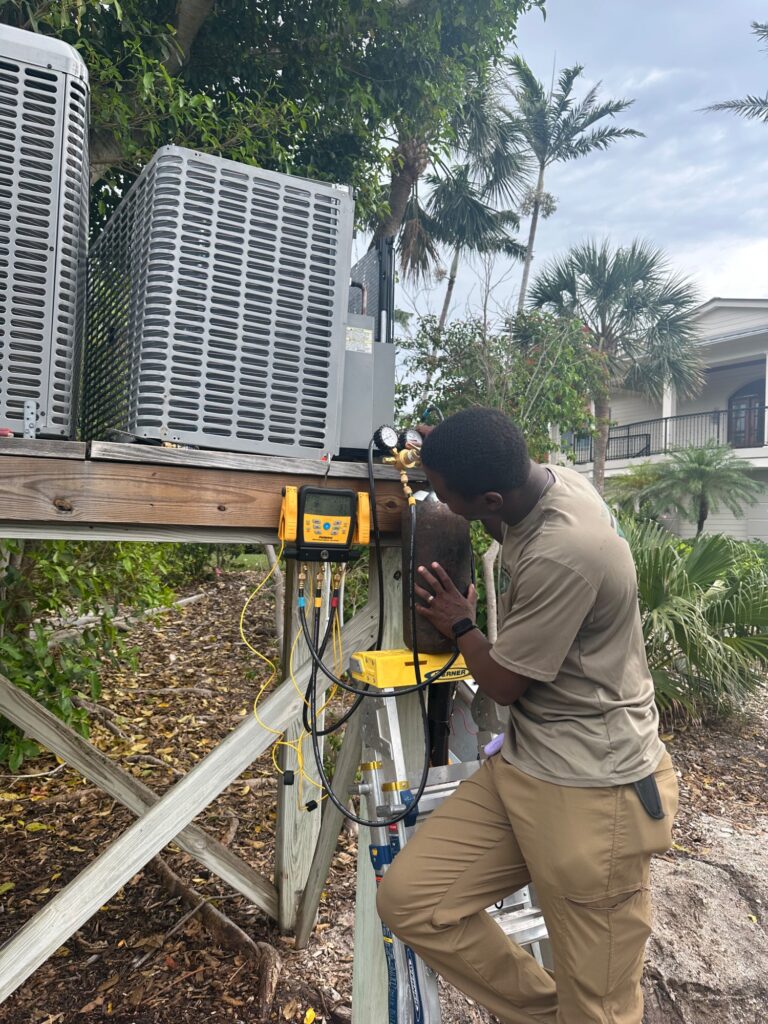
Capacitor testing is one of the highest-value items on our maintenance checklist in this climate, because capacitor failure is the single most common AC repair call in Southwest Florida and Florida’s heat degrades these components faster than almost any other domestic environment. We test both the start and run capacitors for the compressor and condenser fan motor under load, which gives us actual performance data rather than a visual inspection that tells us very little about a component that looks fine but is performing below specification.
A capacitor that tests at 70 percent of its rated value is not failing yet, but it is declining, and in a climate where summer temperatures will stress it further for months, replacing it proactively during the maintenance visit is significantly more convenient than replacing it as an emergency call when it fails completely on a 95-degree afternoon. We discuss these findings with customers and let them decide how to proceed.
Condenser Coil Cleaning
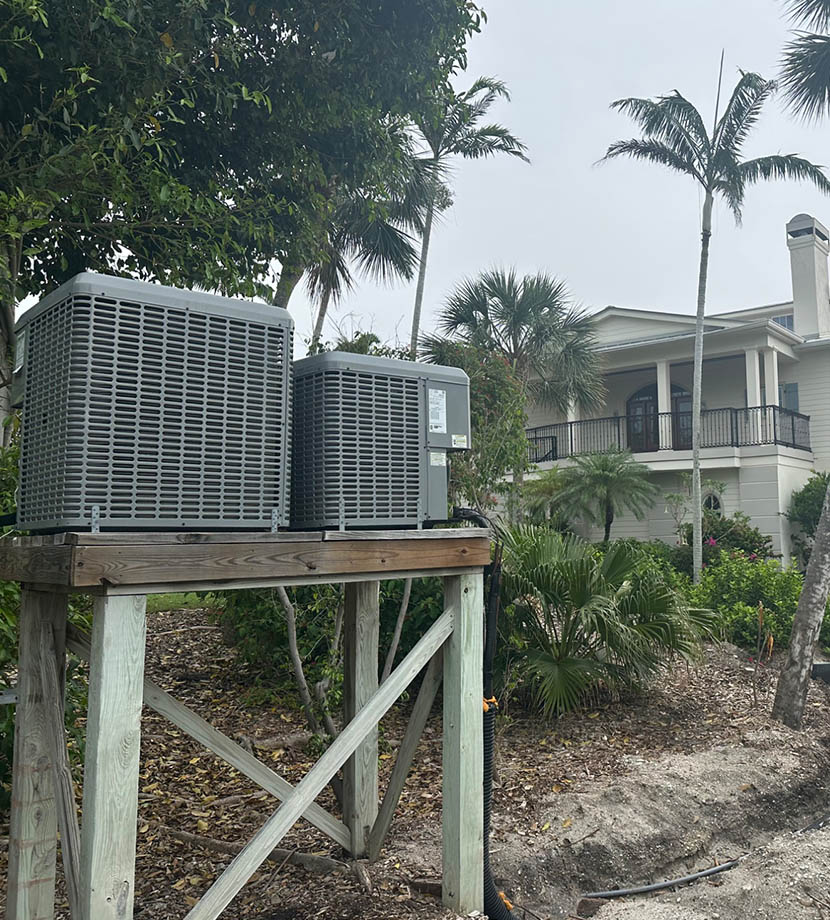
We clean the condenser coil on every maintenance visit using appropriate coil cleaner and low-pressure rinse. For coastal properties on Sanibel Island, Captiva Island, and Fort Myers Beach where salt spray contributes to coil fouling, we use condenser coil treatments that include corrosion inhibitors appropriate for the salt air environment.
Refrigerant System Evaluation
We check refrigerant system performance on every maintenance visit by measuring suction and discharge pressures, superheat and subcooling values, and the temperature differential across the evaporator coil. This data tells us whether the refrigerant charge is within the manufacturer’s specification and whether the system is performing as designed. It also gives us a trend line when compared to previous visit data, which can reveal a slow leak that has not yet produced obvious symptoms.
We do not add refrigerant during a maintenance visit as a matter of routine. If the data indicates the charge is low, we investigate for a leak before recommending any recharge. Adding refrigerant to a system with an unrepaired leak accomplishes nothing lasting and delays the proper repair.
Electrical Component Inspection
Beyond the capacitors, we inspect all electrical connections in both the air handler and the outdoor unit, checking for corrosion, loose terminals, and wire insulation condition. We check the contactor for pitting and wear. We confirm the disconnect box and breaker are in proper condition. We verify that the voltage supply to the outdoor unit is within the acceptable range for the equipment.
In older homes throughout McGregor Isles, Whiskey Creek, and the Villas area in Fort Myers, and in the established waterfront communities along the Caloosahatchee corridor, we sometimes find electrical connections that have corroded or loosened over the decades and are contributing to resistance and heat generation at those points. Addressing these during a maintenance visit prevents them from becoming a more significant electrical issue in the system.
System Performance Documentation
At the end of every maintenance visit, we document the key performance data from the visit, the temperature differential across the coil, capacitor test values, refrigerant system pressures and temperatures, blower motor current, and any specific findings or recommendations. This documentation goes to you and stays in our records for reference on future visits.
Over time, this record tells a story about your system’s trajectory. A system where the capacitor values are declining from visit to visit, where the coil needs cleaning more aggressively each time, or where refrigerant pressures are trending away from the ideal range is a system that may be approaching the end of its useful life. That information is valuable for planning purposes and for making informed decisions about repair versus replacement when the time comes.
Recent Customer Reviews
EXCELLENTTrustindex verifies that the original source of the review is Google. Germayne T. was very professional, courteous, and extremely efficient replacing two ceiling fans for us. Will definitely use Mabry and Germaine again.Posted on GoogleTrustindex verifies that the original source of the review is Google. Just had a biannual service done to my AC, amazing work by Kirk, on time, professional, and efficient!!!Posted on GoogleTrustindex verifies that the original source of the review is Google. Our A/C system wasn’t cooling. Kirk was over to fix it in less than 2 hrs. Very friendly & efficient. Found 2 small leaks. Got system cooling. Went over all options & charges before proceeding. Very satisfied.Posted on GoogleTrustindex verifies that the original source of the review is Google. Amazing professional service! I had smoke detectors falsely alarming and when I called in the morning, Scott immediately had a tech rerouted to address the alarms. Germaine arrived with 15 minutes of my call. He was AWESOME! Knowledgeable, polite and so personable. 5 star🌟 . And that is what we have found with all Mabry Brothers service techs!!!!Posted on GoogleTrustindex verifies that the original source of the review is Google. I love using these guys when I need an electrician. Their prices are fair, service is always fast and on time, and they communicate really well. Today Germayne T came out to install an EV charger at our home. He was on time, worked hard trenching ~80’, and got creative to help minimize the amount of exposed PVC. His connections look great, and the charger is working perfectly. As I said, I really like working with Mabry, and I think you will too.Posted on GoogleTrustindex verifies that the original source of the review is Google. My AC randomly went out in the late afternoon and I thought it had to do with the battery on the thermostat or the filter needing to be changed but it ended up being 84 degrees in my house in the middle of the night and Kirk was able to get to me within an hour of me calling to fix my issue which happened to be the capacitor. He spotted the issue within 10 minutes, thank you so much!!!Posted on GoogleTrustindex verifies that the original source of the review is Google. Company was very responsive. Germayne was knowledgeable, efficient, and cleaned up after work. Very professional! I highly recommend Mabry Brothers for your electrical needs.Posted on GoogleTrustindex verifies that the original source of the review is Google. I was very pleased with the service call. Kirk arrived on time, was professional and knowledgeable about the problems we were having with our air conditioner. He explained in detail what was happening and the steps needed to correct them. I highly recommend Mabry Brothers.Posted on GoogleTrustindex verifies that the original source of the review is Google. We needed an outdoor low voltage circuit installed! Emailed Scott for a quote with quick turnaround and Martin showed up and did excellent install work! Can highly recommend Mabry Brothers from this first experience and will use again!Posted on GoogleTrustindex verifies that the original source of the review is Google. Troy from Mabry Brothers is extremely professional and truly knows 100% what he’s doing. He is very responsible and takes the time to explain every step of the process, including every part that needs to be replaced. After calling several different companies, nobody was able to repair my generator and I only ended up wasting money. Troy was the only one who actually solved the problem quickly, and now my generator is working perfectly just in time for the upcoming storms. I highly recommend Troy and Mabry Brothers to anyone looking for honest, knowledgeable, and reliable service.
Frequently Asked Questions
Need Service in Southwest Florida?
The licensed electricians and HVAC technicians at Mabry Brothers have served Fort Myers, Estero, Bonita Springs, Naples, Sanibel Island, and Captiva Island since 1995.
For immediate assistance, please call our office directly at (239) 482-1122.

