
What Is a Variable-Speed Air Conditioner and Why Does It Matter in Southwest Florida?
If you are replacing an air conditioning system in Southwest Florida right now, the single most important technology question is whether to go with a single-stage or variable-speed system. We recommend variable-speed in most cases throughout our service area, and we want to explain why in enough detail that you can make a genuinely informed decision rather than simply taking our word for it.
The short version: in a climate where humidity control matters as much as temperature control, where the system runs essentially year-round, and where energy efficiency savings multiply across thousands of cooling hours annually, variable-speed technology delivers benefits that single-stage systems of equivalent capacity cannot match. The longer version involves understanding how these systems actually work differently from each other.
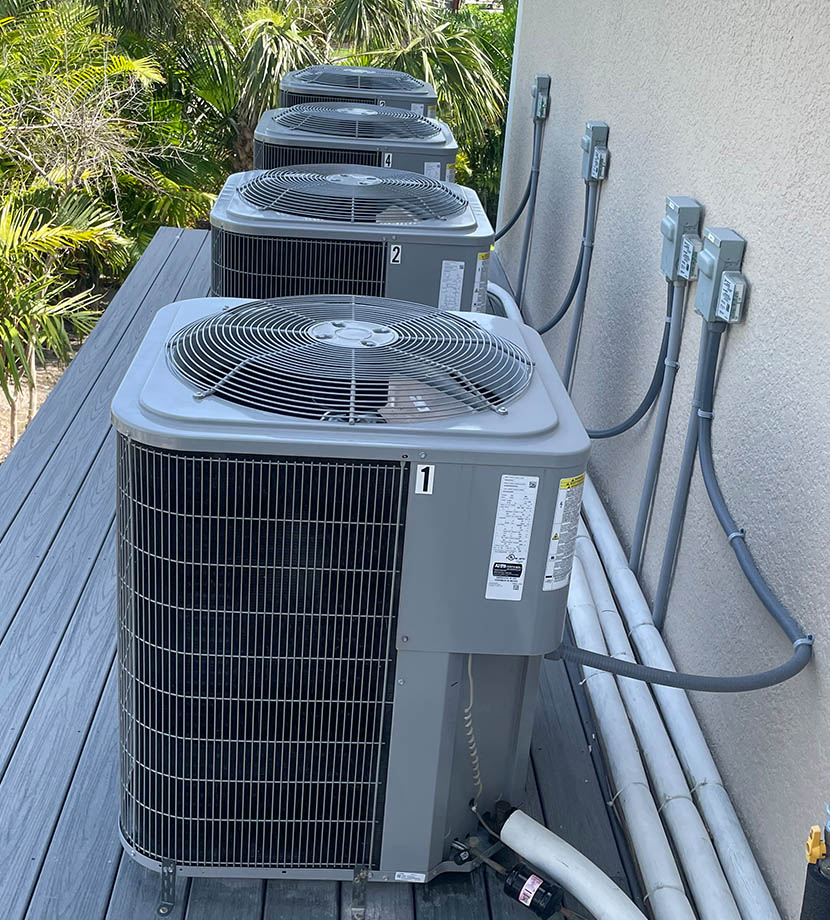
How Single-Stage Systems Work
A single-stage air conditioner operates at one speed: full capacity. When the thermostat calls for cooling, the compressor and outdoor fan run at maximum output. When the setpoint is reached, everything shuts off. Then as the home warms back up by a degree or two, the system runs at full capacity again until the setpoint is reached again.
This on/off cycling pattern, called short-cycling when the on-periods are brief, is the fundamental limitation of single-stage technology in Southwest Florida’s climate. A full-capacity run that lasts 8 to 12 minutes is maintaining temperature but not completing meaningful dehumidification. The home cools to the thermostat reading but the air feels heavy and damp because the system has not run long enough to remove significant moisture from it.
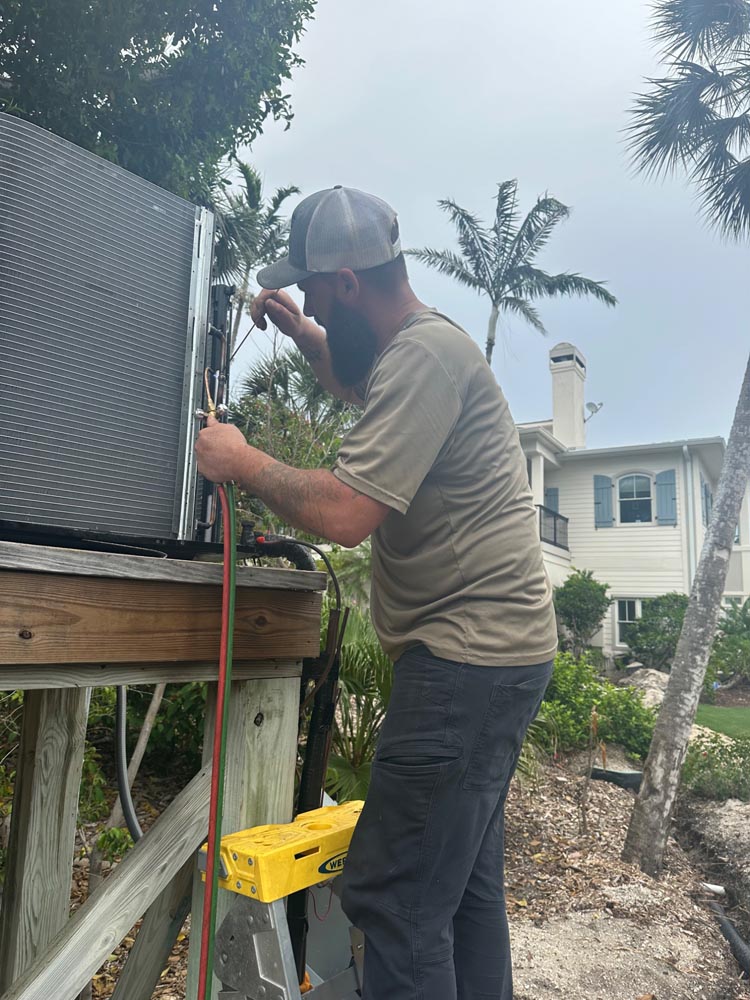
How Variable-Speed Systems Work
This modulation means the system runs for much longer periods at lower output levels rather than cycling on and off repeatedly at full capacity. That extended operation at lower speed is what changes the humidity equation entirely. More time running means more time moving air across the cold evaporator coil, which means more moisture condensing out of the air. The home reaches and maintains both the temperature setpoint and a comfortable humidity level simultaneously.
The Humidity Control Difference in Southwest Florida
This is the benefit we emphasize most strongly to homeowners throughout our service area because it is the one they feel most directly and notice most immediately after installation. Southwest Florida’s outdoor relative humidity is persistently high through our long warm season. Every time a door opens, every breath taken indoors, and every infiltration pathway in the building envelope is bringing moisture into the conditioned space. The AC system’s ability to remove that moisture continuously is what separates a comfortable home from a clammy one.
Homeowners who have lived in a home with a single-stage system and moved into one with a variable-speed system consistently describe the difference in sensory terms: the air feels lighter, cleaner, and more genuinely comfortable even when the thermostat reads the same temperature. That is dehumidification quality in action, and it is something a SEER rating number does not fully capture.
We see this most clearly in homes throughout communities like Talis Park, The Ritz-Carlton Residences, and similar high-quality construction in Naples, and in premium custom homes throughout Pelican Bay, Quail West, and Grey Oaks, where the home’s finishes, furnishings, and quality of construction make the performance difference from a properly selected variable-speed system immediately apparent to discerning occupants.
Energy Efficiency and What It Means in Florida's Climate
Variable-speed systems earn higher SEER2 ratings because they operate more efficiently across a range of partial-load conditions, which represents the vast majority of actual operating hours. Running at 40 to 60 percent of maximum capacity is more efficient per unit of cooling delivered than running at 100 percent and cycling off. The efficiency advantage multiplies in Southwest Florida because of the sheer number of hours these systems run each year.
For homeowners in FPL and LCEC service territories throughout our service area, variable-speed systems typically qualify for rebates through utility efficiency programs, and many meet the requirements for federal energy efficiency tax credits. Our team documents qualifying equipment appropriately and can advise on available incentive programs at the time of installation.

Noise, Comfort, and Consistency
Variable-speed systems are also meaningfully quieter than single-stage systems in normal operation. Running at 40 to 60 percent of maximum capacity produces significantly less sound than full-output operation, and the absence of the repeated loud startup-and-shutdown cycling that characterizes single-stage systems makes the home environment noticeably calmer. In homes throughout Mediterra, Quail West, and similar communities where quiet and comfortable living are central to the property’s appeal, this is not a minor consideration.
Temperature consistency is also improved. Instead of the temperature swinging between 1 to 2 degrees below setpoint immediately after a cycle and 1 to 2 degrees above setpoint before the next cycle, a variable-speed system maintains the thermostat setpoint within a fraction of a degree. Over the course of a day, the home feels consistently comfortable rather than cycling between slightly too cool and slightly too warm.
Variable-Speed Systems and the Homes That Benefit Most
Variable-speed technology benefits virtually every Southwest Florida home, but the benefit is most pronounced in specific situations. Homes with chronic humidity problems despite functioning AC equipment see the most dramatic improvement. Homes where temperature consistency and quiet operation matter most see clear benefits. Homes with large open floor plans or challenging architectural configurations that make even temperature distribution difficult respond well to the more continuous, controlled airflow that variable-speed systems provide.
Large custom homes throughout Southwest Florida, from waterfront estates in Naples and Marco Island to the luxury developments of Bonita Bay and Quail West, typically receive variable-speed systems as a matter of course because the quality of living environment these homes are intended to provide requires the best available technology in every system. For more modest homes throughout Lehigh Acres, North Fort Myers, and older sections of Bonita Springs, the comfort improvement from variable-speed technology is equally real, and the energy efficiency gains that offset the initial investment premium are proportionally meaningful given the long operating season.
Recent Customer Reviews
EXCELLENTTrustindex verifies that the original source of the review is Google. Germayne T. was very professional, courteous, and extremely efficient replacing two ceiling fans for us. Will definitely use Mabry and Germaine again.Posted on GoogleTrustindex verifies that the original source of the review is Google. Just had a biannual service done to my AC, amazing work by Kirk, on time, professional, and efficient!!!Posted on GoogleTrustindex verifies that the original source of the review is Google. Our A/C system wasn’t cooling. Kirk was over to fix it in less than 2 hrs. Very friendly & efficient. Found 2 small leaks. Got system cooling. Went over all options & charges before proceeding. Very satisfied.Posted on GoogleTrustindex verifies that the original source of the review is Google. Amazing professional service! I had smoke detectors falsely alarming and when I called in the morning, Scott immediately had a tech rerouted to address the alarms. Germaine arrived with 15 minutes of my call. He was AWESOME! Knowledgeable, polite and so personable. 5 star🌟 . And that is what we have found with all Mabry Brothers service techs!!!!Posted on GoogleTrustindex verifies that the original source of the review is Google. I love using these guys when I need an electrician. Their prices are fair, service is always fast and on time, and they communicate really well. Today Germayne T came out to install an EV charger at our home. He was on time, worked hard trenching ~80’, and got creative to help minimize the amount of exposed PVC. His connections look great, and the charger is working perfectly. As I said, I really like working with Mabry, and I think you will too.Posted on GoogleTrustindex verifies that the original source of the review is Google. My AC randomly went out in the late afternoon and I thought it had to do with the battery on the thermostat or the filter needing to be changed but it ended up being 84 degrees in my house in the middle of the night and Kirk was able to get to me within an hour of me calling to fix my issue which happened to be the capacitor. He spotted the issue within 10 minutes, thank you so much!!!Posted on GoogleTrustindex verifies that the original source of the review is Google. Company was very responsive. Germayne was knowledgeable, efficient, and cleaned up after work. Very professional! I highly recommend Mabry Brothers for your electrical needs.Posted on GoogleTrustindex verifies that the original source of the review is Google. I was very pleased with the service call. Kirk arrived on time, was professional and knowledgeable about the problems we were having with our air conditioner. He explained in detail what was happening and the steps needed to correct them. I highly recommend Mabry Brothers.Posted on GoogleTrustindex verifies that the original source of the review is Google. We needed an outdoor low voltage circuit installed! Emailed Scott for a quote with quick turnaround and Martin showed up and did excellent install work! Can highly recommend Mabry Brothers from this first experience and will use again!Posted on GoogleTrustindex verifies that the original source of the review is Google. Troy from Mabry Brothers is extremely professional and truly knows 100% what he’s doing. He is very responsible and takes the time to explain every step of the process, including every part that needs to be replaced. After calling several different companies, nobody was able to repair my generator and I only ended up wasting money. Troy was the only one who actually solved the problem quickly, and now my generator is working perfectly just in time for the upcoming storms. I highly recommend Troy and Mabry Brothers to anyone looking for honest, knowledgeable, and reliable service.
Frequently Asked Questions
Need Service in Southwest Florida?
The licensed electricians and HVAC technicians at Mabry Brothers have served Fort Myers, Estero, Bonita Springs, Naples, Sanibel Island, and Captiva Island since 1995.
For immediate assistance, please call our office directly at (239) 482-1122.

